
 English
 中文简体
中文简体Right Angle Gear Reducer: Types, Selection Criteria, and Buying Tips
Aug 07, 2026
Content
- 1 What a Right Angle Gear Reducer Is and When to Specify One
- 2 Main Types of Right Angle Gear Reducers
- 3 Ratings That Decide Whether a Right Angle Reducer Survives
- 4 Applications That Punish Right Angle Reducers Most
- 5 What to Put in an Enquiry So the Factory Gets It Right
- 6 Quality Checks and Red Flags When Choosing a Manufacturer
- 7 Cost and Lead Time Reality Check
- 8 Bottom Line: Make the Selection in the Right Order
What a Right Angle Gear Reducer Is and When to Specify One
A design engineer walks along a conveyor line and sees the motor mounted sideways, with the gearbox output shaft pointing down into the chain wheel. The layout saves headroom and keeps walkways clear. That arrangement is only possible because a right angle gear reducer sits between the motor and the driven machine.
A right angle gear reducer is a speed-reducing gearbox whose input and output shaft axes meet at 90 degrees. Specify one whenever the motor cannot be placed in line with the driven shaft and you want to turn power around a corner while reducing speed and raising torque in a single compact housing.
The practical advantages are clear: shorter machine footprint, fewer belt or chain transfer stages, and more freedom in placing the motor. The trade-off is that gear geometry, efficiency, and lubrication deserve closer attention than with an in-line reducer, especially on continuous or shock-loaded duties.
Main Types of Right Angle Gear Reducers
Right angle reducers are usually grouped by the gear pair that creates the 90-degree turn. Each family has distinct ratio, efficiency, and load characteristics.
| Type | Ratio Range (Single Stage) | Efficiency | Load Behavior | Best For |
|---|---|---|---|---|
| Single enveloping worm gear | 5:1-60:1 | 50-90% depending on ratio | Smooth and quiet, moderate shock tolerance | General conveyors, mixers, gate drives |
| Double enveloping worm gear | 5:1-60:1 | Higher contact area than single enveloping | Better resistance to shock and vibration | Cranes, mills, heavy industrial drives |
| Spiral bevel gear | 1:1-6:1 | 95-98% | High-speed, low-ratio operation | Right angle power take-offs at high speed |
| Right-angle planetary | 10:1-100:1 multi-stage | 90-97% | High torque density in a compact body | Servo drives and confined machine axes |
Single Enveloping Worm Gear Reducers
In this design, the worm wheel wraps partially around the worm, forming a single enveloping contact. Single enveloping worm reducers are the most economical way to get a right angle output at ratios up to 60:1. They run smoothly and quietly, and they absorb moderate shock without complexity. Their efficiency falls as the ratio rises, so a 10:1 unit may pass around 90% of input power while a 60:1 unit is closer to 60-70%. For standard industrial right angle drives, a single enveloping worm gear reducer usually offers the best value per rated newton-meter.
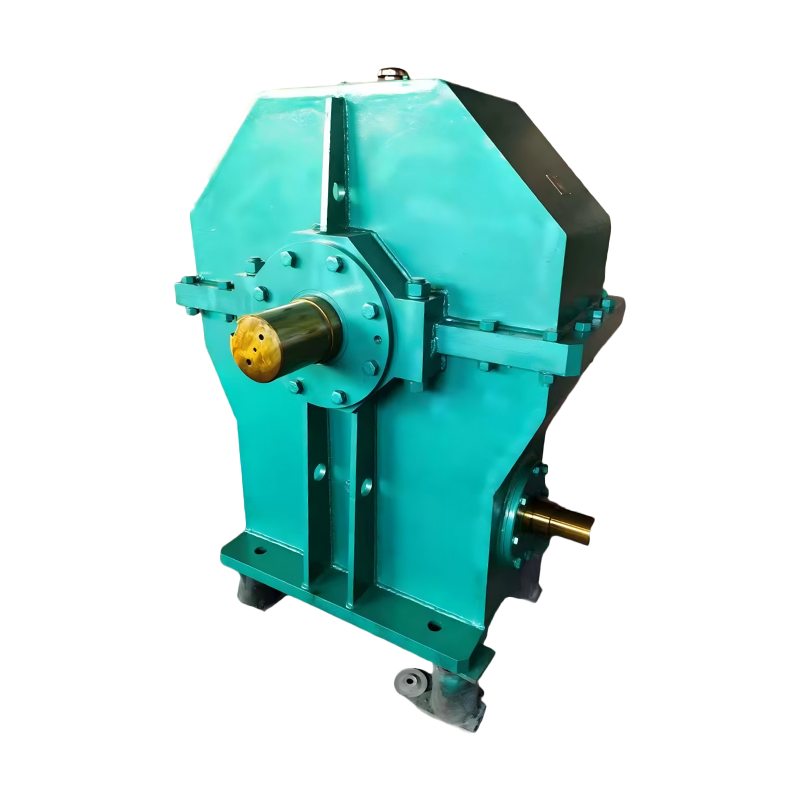 Single-Enveloping Worm Gear Reducer Manufacturer, FactoryTaixing Reducer is a China Single-Enveloping Worm Gear Reducer manufacturer & factory, with years of experience in industrial speed reduc...View Product →
Double Enveloping Worm Gear Reducers
Here the worm and the wheel envelop each other, so more tooth surface stays in contact as the load passes through the mesh. That extra contact area cuts surface pressure and gives the reducer higher load capacity for the same center distance. The design suits intermittent heavy starts, reversing loads, and applications where oil film rupture would be a risk. The production cost is higher because the worm thread and wheel form require careful machining and assembly. When you need that toughness, a double enveloping design is an engineering choice rather than simply a more expensive alternative.
Bevel and Right-Angle Planetary Configurations
Spiral bevel reducers achieve excellent efficiency and are preferred when the needed ratio is low and speeds are high. They cost more per stage and are often combined with planetary stages to produce right-angle planetary units. These are compact and efficient, but the premium price is justified only when space or dynamic performance is the main constraint. For most heavy industrial applications, worm-type right angle reducers remain the practical baseline.
Ratings That Decide Whether a Right Angle Reducer Survives
Select by torque first, ratio second, and efficiency third. Many failed selections start with a ratio calculation and skip the service factor, so the reducer is geometrically correct but mechanically undersized.
Output Torque and Service Factor
Required output torque equals driven load torque multiplied by a service factor. For steady uniform loads, a factor of 1.0-1.25 is common; conveyors with frequent starts, mixers, and shock-loaded equipment need 1.5-1.75 or higher. The selected gearbox must be rated at or above the result, not above the nominal motor power.
Ratio and Output Speed
Ratio is input speed divided by required output speed. A 1720 rpm motor driving a 28 rpm drum requires a 61.4:1 ratio, so a standard 60:1 unit may be close enough only after verifying actual output speed and torque at that speed. For a 60 Hz supply in the United States, a four-pole motor runs near 1750 rpm, while a 50 Hz supply delivers about 1450 rpm. Confirm the actual input speed; a ratio selected for the wrong line frequency shifts output speed by roughly 20%. Common worm reducer ratios include 10, 15, 20, 25, 30, 40, 50, 60, and 80.
Efficiency and Thermal Limits
Worm reducers convert a portion of input power into heat, and the share grows with ratio. At continuous duty, the housing must dissipate that heat through ribs, oil circulation, and adequate oil volume. If a machine runs 24 hours a day near rated torque, choose a frame size with higher thermal capacity even if the mechanical rating looks sufficient. Let the manufacturer know the duty cycle and ambient temperature.
Backlash and Positioning Behavior
For reversing loads, turntables, and positioning axes, ask for a stated backlash value and check how it is adjusted. Double enveloping worm sets maintain contact over a wider zone, which helps keep mesh stability over time. Do not rely on self-locking for emergency stops; it is a static behavior and varies with ratio, lead angle, and lubrication.
Applications That Punish Right Angle Reducers Most
Heavy loads expose the difference between a cheap right angle unit and one that is properly rated. The highest-risk duties include:
- Belt conveyors with heavy start-up torque and long loaded belts
- Mixers and agitators that run continuously and generate heat
- Crane travel and hoisting drives that reverse frequently
- Gate hoists and valve drives that must hold position under load
- Rotary feeders and turntables with uneven load distribution
In these applications, the failure point is usually the tooth surface or the oil film between the worm and wheel. A double enveloping worm gear reducer spreads the contact pressure across a larger area, which reduces the risk of scuffing and extends service life on shock-loaded drives. For demanding industrial environments, this design is one of the most cost-effective upgrades you can specify.
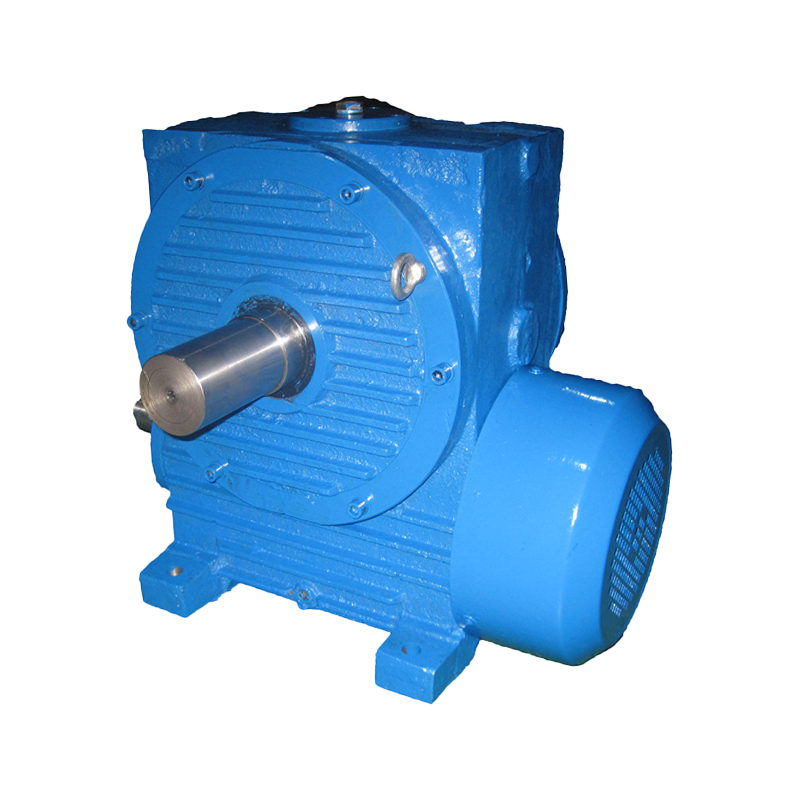 Double-Enveloping Worm Gear Reducer Manufacturer, FactoryTaixing Reducer is a China Double-Enveloping Worm Gear Reducer manufacturer & factory, with years of experience in industrial speed reduc...View Product →
What to Put in an Enquiry So the Factory Gets It Right
A precise enquiry shortens the quoting cycle and prevents the wrong frame size from arriving at the job site. Include at least the following data:
| Parameter | How to State It | Why It Matters |
|---|---|---|
| Output torque requirement | Nm at the output shaft, including overload peaks | Determines center distance, module, and housing size |
| Input motor power and speed | kW and rpm | Establishes ratio, input shaft loads, and coupling size |
| Duty cycle | Hours per day and starts per hour | Sets mechanical and thermal rating |
| Mounting orientation | Output shaft up, down, or horizontal | Confirms oil level, breather, and seal layout |
| Shaft configuration | Solid shaft or hollow bore, keyed or splined | Determines coupling and installation method |
| Environment | Ambient temperature, dust, washdown, outdoor exposure | Affects seals, breather, paint, and oil grade |
Most factories select the frame from their rating tables, then verify it against both mechanical and thermal limits. If the supplier does not ask about duty cycle or mounting orientation, treat that as a warning sign.
Quality Checks and Red Flags When Choosing a Manufacturer
The easiest way to judge a right angle reducer is to look at the production process, not just the data sheet. Factory evidence matters more than marketing language.
- Hardened and ground worm threads. A ground, heat-treated worm wears longer and maintains efficiency; hobbed-only worms are cheaper but soften under continuous service.
- Worm wheel material. Tin-bronze wheels resist scuffing and embed minor contamination; confirm the alloy for high-load designs.
- Machining capacity. Gear housings machined on rigid boring centers and large gear grinders hold better tooth geometry. A factory with imported large gear grinders, hobbing machines, and boring centers, including a 3-meter gear grinder and a 3.2-meter hobbing machine, is better positioned to control quality on large worm drives.
- Run-in and test procedure. Ask whether each unit is run-in and checked for noise, vibration, oil leaks, and temperature rise.
- Product breadth and experience. A manufacturer producing 16 series and more than 10,000 specifications, with over 2,000 employees and roughly 186 engineering and technical professionals, is more likely to have documented design experience than a small assembly shop.
Established in 1984, Taixing Reducer Co., Ltd. reports an annual production capacity of 200,000 units and a 99.8% customer satisfaction rate, and it supplies reducers to major industrial projects. These are self-reported figures, but they give you a reason to request references for a reduction ratio and load class similar to yours.
Cost and Lead Time Reality Check
Right angle reducers span a wide price range, and the difference is rarely about markup. Single enveloping worm units are the economic baseline. Double enveloping units cost more because the tooth geometry and assembly require additional machining and quality control, but the higher load capacity often allows a smaller center distance for the same torque. Bevel and right-angle planetary units cost more again and make sense only when efficiency, compactness, or dynamic performance dominates the design.
Lead time depends mostly on center distance and whether the ratio is standard. Large non-standard center distances, special shaft extensions, or high-ratio custom wheels can push delivery by several weeks. Ordering multiple identical units for one project reduces setup cost and usually shortens the overall schedule.
The final price should be weighed against downtime cost. A marginally cheaper reducer that fails on a continuous mixer or a crane travel drive costs far more in lost production and replacement labor.
Bottom Line: Make the Selection in the Right Order
The reliable path to a correct right angle gear reducer is straightforward. Confirm that the input and output axes are perpendicular, calculate output torque with a realistic service factor, then select a reduction ratio and verify the mechanical and thermal ratings. Compare single enveloping and double enveloping worm designs for the duty type, and check the manufacturer's machining capability, materials, and test procedure.
Start with the application, not the catalog. For space-saving right angle drives, a single enveloping worm reducer delivers the most cost-effective baseline. When shock loads or continuous heavy service are in the picture, the double enveloping design earns its higher initial price. In both cases, a factory with decades of gear manufacturing experience gives you a strong basis for a first production batch.
Related Products


Contact us
-
Factory Address
No. 10, Taiyao North Road, Yaowang Town, Taixing City, Jiangsu Province, China
-
Phone
86-139 5115 9007
Copyright © TAIXING REDUCER CO., LTD. Rights Reserved.
China industrial gear reducer manufacturer Custom speed reducer supplier