 English
 中文简体
中文简体Content
- 1 What Is an Extruder Hardened Gear Reducer?
- 2 Why Extruders Demand Hardened Gears
- 3 Hardened vs. Medium-Hard vs. Soft Tooth Surfaces
- 4 Extruder Reducer Selection Criteria
- 5 Four Failure Modes Hardened Gears Prevent
- 6 Matching the Reducer to Your Extrusion Process
- 7 Extruder Hardened Gear Reducer Buying Checklist
- 8 FAQ: Extruder Hardened Gear Reducers
- 9 Final Recommendation
What Is an Extruder Hardened Gear Reducer?
An extruder hardened gear reducer is a heavy-duty speed reducer with case-hardened, ground gear teeth - typically 58-62 HRC on the tooth flank - engineered to drive single-screw and twin-screw extruders under continuous, high-torque conditions. Hardened tooth surfaces are the single difference between a gearbox that holds its accuracy for decades and one that develops backlash, noise and vibration within a few seasons of production.
Extrusion is not an occasional-duty application. A plastics or rubber extruder runs around the clock, pushes viscous polymer melt through a die at a nearly constant screw speed, and can hit torque spikes during start-up, cold runs and feedstock variation. The reducer is the mechanical heart of the drive train: it steps motor speed down to the 20-150 rpm typical of extrusion screws, multiplies torque and must do so with minimal downtime. This is why understanding how an industrial gear reducer works and which type fits your drive matters before you put a specification together.
This guide explains what hardened gearing changes in practice, how it compares with soft and medium-hard alternatives, which selection parameters matter most and how to match a reducer to a specific extrusion process.
Why Extruders Demand Hardened Gears
Extruder drives fail by surface fatigue before they fail by strength, which is why hardened gears are the industry default for continuous extrusion duty.
The load cycle is punishing. Round-the-clock operation means gear teeth pass through mesh millions of times per year, and at each mesh the Hertzian contact stress on the tooth flank is high. Over time that stress initiates micro-cracks that grow into pitting. Soft or normalized gears at roughly 180-220 HB simply do not have the surface fatigue resistance for this duty. Their flanks wear, backlash grows, noise rises, and the screw speed signal becomes unsteady - which shows up directly as dimensional variation in the extruded product.
The same mechanism wears out small extruder gears on desktop machinery: a brass gear in a lightweight extruder can show visible wear after a few months of hobby use. In an industrial extruder the physics are identical, only the replacement cost, downtime and scrap rate are thousands of times higher. Hardened gears, carburized to 58-62 HRC and finish-ground, resist pitting and adhesive wear and keep the reducer's original accuracy for a far larger share of its mechanical life.
Add thermal stress and contamination. Extruder halls are hot, and polymer dust or degraded material can reach the gearbox through seals. Hardened flanks tolerate marginal lubrication and fine contamination far better than softer materials, which is the practical reason processors keep specifying them.
Hardened vs. Medium-Hard vs. Soft Tooth Surfaces
For extruder drive selection, tooth surface hardness is the most decisive parameter: it sets load capacity, wear life and the economics of the eventual rebuild.
| Parameter | Soft Tooth Surface | Medium-Hard Tooth Surface | Hardened Tooth Surface |
|---|---|---|---|
| Typical surface hardness | HB 180-220 | HB 300-360 / HRC 35-45 | HRC 58-62 |
| Heat treatment | Normalizing or quench-temper | Induction hardening / nitriding | Carburizing plus finish grinding |
| Relative torque capacity | 1.0 (baseline) | 1.5-1.8 | 2.5-3.0 |
| Shock-load resistance | Low | Moderate | High |
| Pitting and wear life | Shortest | Intermediate | Longest |
| Typical efficiency | 96-97% | 97-98% | 97-98.5% |
| Best suited for | Intermittent, light extruder duty | Cyclic, medium-duty lines | Continuous 24/7 extrusion |
Carburized-and-ground gears are preferred for extruders because grinding corrects heat-treatment distortion, so flank profile and lead accuracy can reach DIN class 5-6 quality. The combination of a hard case and a tough, lower-carbon core gives teeth that resist both surface damage and bending fatigue. Medium-hard gears sit in between and can handle lighter cyclic work, but they remain marginal for round-the-clock polymer extrusion.
Extruder Reducer Selection Criteria
Four parameters decide whether a reducer survives extrusion duty: torque capacity and service factor, ratio and output speed, thermal rating, and mounting or thrust arrangement.
Torque and Service Factor
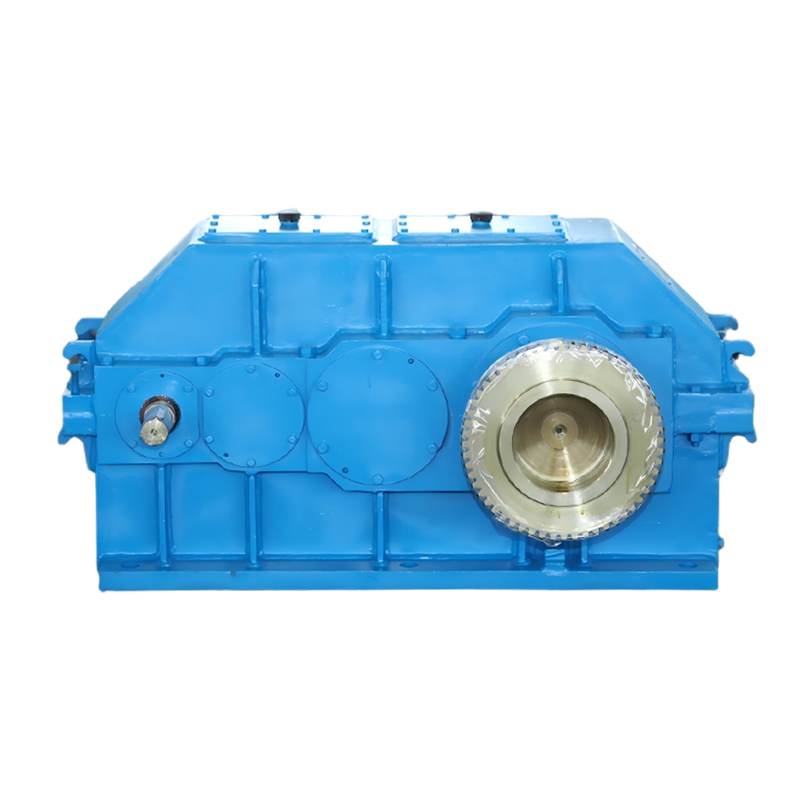
Size an extruder reducer with a service factor of at least 1.5, and 1.75-2.0 for twin-screw lines or highly filled compounds. Start-up torque, cold polymer and occasional screw jams all exceed steady-state load. A hardened tooth surface cylindrical gear reducer is the conventional first choice here: it packs high torque into a compact footprint and absorbs the momentary overloads typical of extruder start-up.
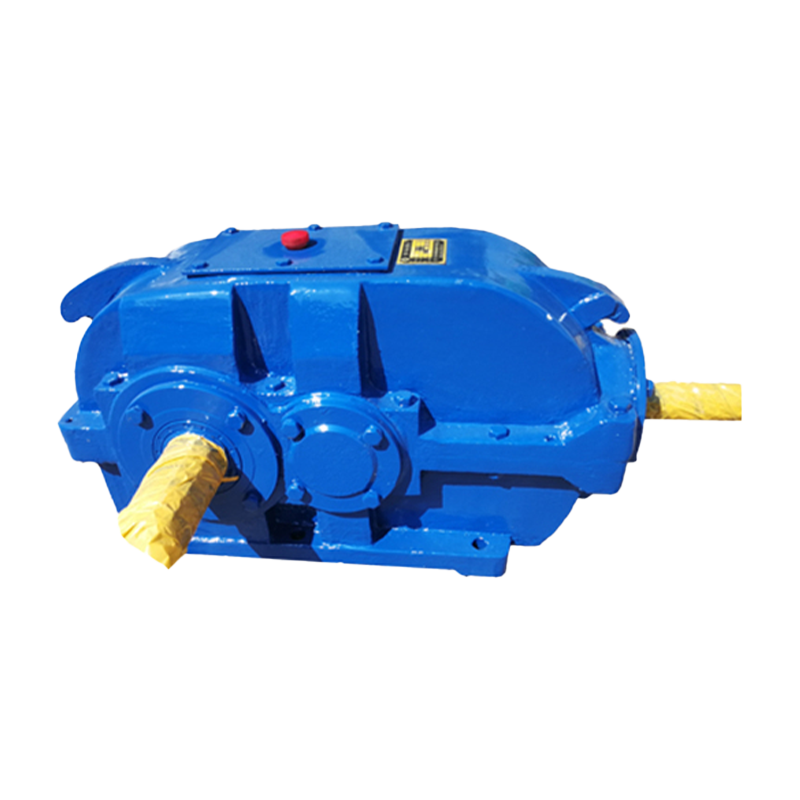 Hard-Tooth Surface Cylindrical Gear Reducer Manufacturer, FactoryTaixing Reducer is a China Hard-Tooth Surface Cylindrical Gear Reducer manufacturer & factory, with years of experience in industrial spe...View Product →
Ratio and Output Speed
Most extruder screws run between 20 and 150 rpm. A two-stage helical reducer with ratios from roughly 10:1 to 25:1 covers most single-screw lines, while twin-screw compounding may need ratios above 25:1 at higher input speeds. Choose the ratio that places normal operation at 60-80% of the reducer's rated output speed, leaving margin without overspeeding the train.
Thermal Rating and Continuous Power
A reducer can have enough mechanical torque yet overheat in 24/7 service, so compare the thermal power rating - not only the mechanical rating - against actual motor power. If the oil sump temperature is at risk of exceeding 85-90 degrees Celsius, specify forced lubrication with a cooler or increase the frame size. Hardened gearing runs cooler because of lower friction, which directly reduces thermal stress.
Mounting, Shaft Arrangement and Thrust
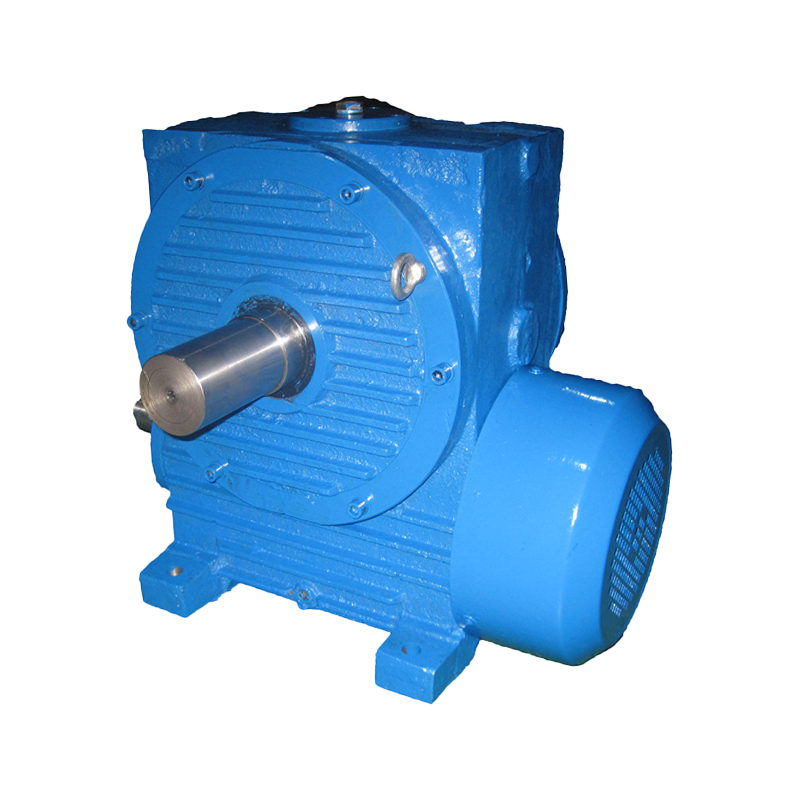
Coaxial reducers suit compact motor-on-top layouts, parallel-shaft reducers offer lower height with large ratios, and planetary reducers provide very high torque density on short center distances. Check the thrust rating whenever the screw axial load is carried by the reducer bearing instead of a separate thrust bearing - a hidden cost in many extruder retrofits. Also confirm that the hollow bore, output flange or foot dimension matches the extruder barrel without awkward adapters.
Four Failure Modes Hardened Gears Prevent
Pitting, scuffing, bending fatigue and abrasive wear account for nearly all extruder gearbox failures, and hardening addresses every one of them.
- Pitting (surface fatigue): repeated contact stress cracks the flank. Hardened flanks at 58-62 HRC resist pitting many times longer than soft flanks at the same transmitted torque.
- Scuffing (adhesive wear): a broken oil film welds and tears microscopic junctions on the tooth surfaces. Ground, hardened flanks with a finish of Ra 0.4-0.8 micron are far more scuff-resistant.
- Tooth bending fatigue: overloads and jams bend the tooth root. The tough core beneath a hardened case keeps the root strong while the case absorbs surface damage.
- Abrasive wear: dust and degraded polymer lap material off the flanks. Hardening slows abrasive loss and preserves the backlash that extrusion quality requires.
Backlash control is a direct quality lever: a worn gearbox produces pulsation at the screw, and pulsation becomes wall-thickness variation in pipe, film and profile. That is why processors specify hardened, ground gearing even when the initial purchase price is higher.
Matching the Reducer to Your Extrusion Process
The right reducer family follows the process: single-screw lines favor hardened helical reducers, high-speed compounding favors planetary types, and flexible plants favor modular gearboxes.
| Extrusion process | Typical screw speed | Duty character | Recommended reducer family |
|---|---|---|---|
| Single-screw film, sheet and pipe | 30-120 rpm | Continuous, steady torque | Hardened helical / parallel shaft |
| Twin-screw compounding | 150-600 rpm | High power density, axial thrust | Planetary gear reducers |
| Rubber and elastomer extrusion | 10-60 rpm | Very high torque, high heat | Hardened cylindrical, generous service factor |
| Profile and pelletizing with frequent stops | 20-150 rpm | Cyclic starts and stops | Modular heavy-duty gearbox |
For a typical single-screw line, the hardened cylindrical family gives the best balance of torque, efficiency and cost when sized with an adequate service factor. Where space is tight and power density is the priority, a planetary gear reducer provides higher torque per unit volume with multiple planet stages. For plants that reconfigure lines or change processes often, a modular heavy-duty gearbox allows interchangeable components and simpler ratio changes over the life of the line.
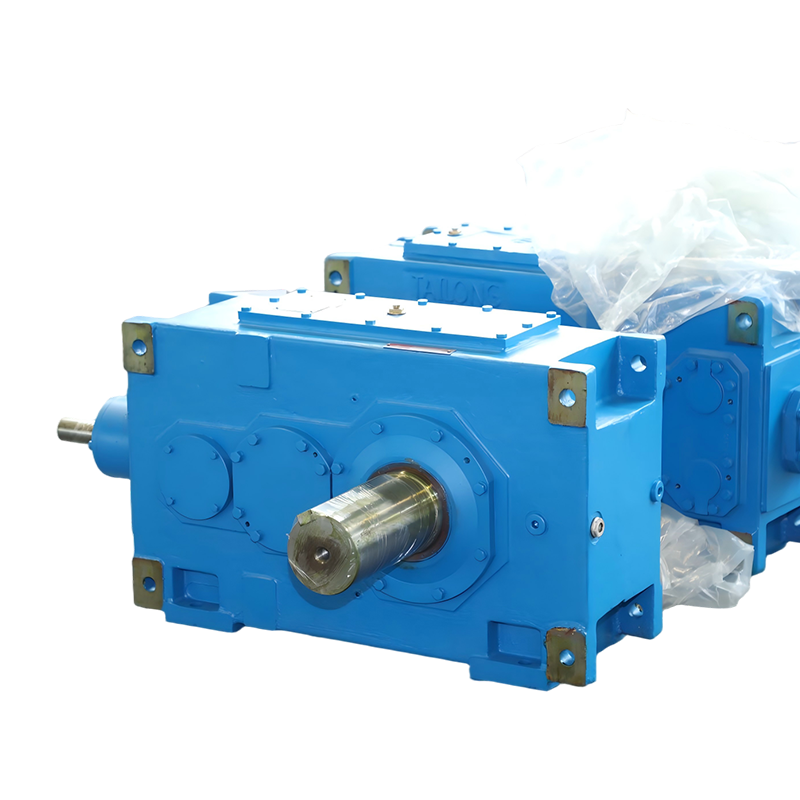 Modular Heavy-Duty Gearbox Manufacturer, FactoryTaixing Reducer is a China Modular Heavy-Duty Gearbox manufacturer & factory, with years of experience in industrial speed reducer. Whole...View Product →
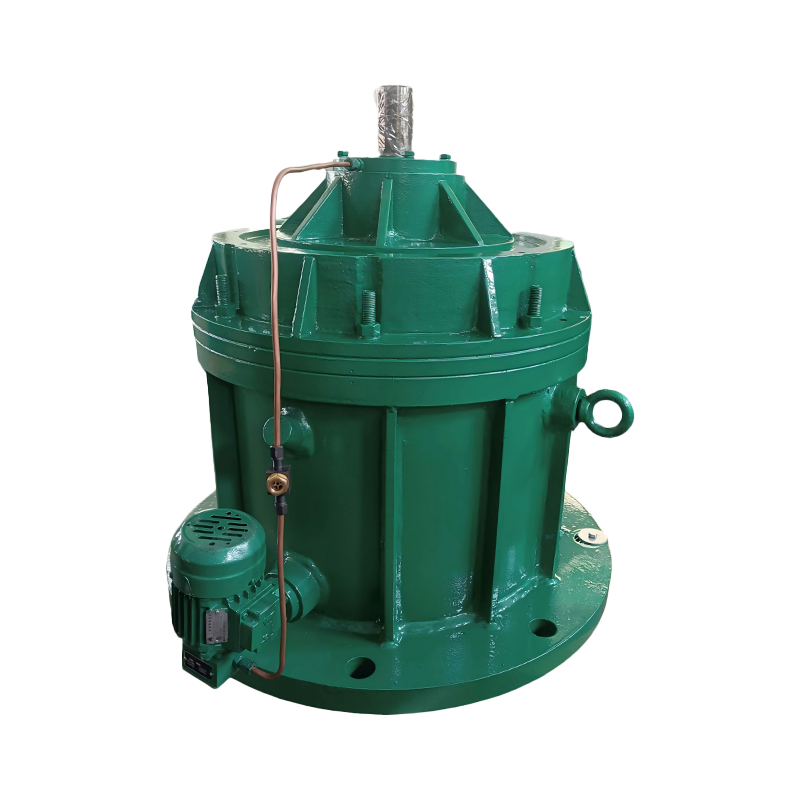 Planetary Gear Reducers Manufacturer, FactoryTaixing Reducer is a China Planetary Gear Reducers manufacturer & factory, with years of experience in industrial speed reducer. Wholesal...View Product →
Extruder Hardened Gear Reducer Buying Checklist
Work through these seven points before ordering; each one has caused a real replacement or rebuild in extrusion plants.
- Calculate required output torque: motor power (kW) x 9550 divided by screw speed (rpm), multiplied by a service factor of at least 1.5.
- Specify tooth surface hardness of at least 58 HRC carburized for continuous extrusion; accept induction hardening only for light cyclic lines.
- Compare thermal power rating against average continuous load, not just the motor nameplate.
- Verify available ratios against the screw speed window: 20-150 rpm for most plastics, up to 600 rpm for compounding.
- Confirm thrust load rating when screw axial force enters the reducer housing.
- Review lubrication mode: splash for small intermittent lines, forced circulation with cooling for 24/7 and high ambient temperatures.
- Request measured noise, vibration and gear accuracy data in DIN or ISO classes, not only catalog ratings.
FAQ: Extruder Hardened Gear Reducers
What does "hardened" mean in a hardened gear reducer?
Hardened refers to the gear tooth surface. The gear is carburized or induction-hardened so the flank reaches high hardness while the core stays tough. In industrial extruder reducers, the standard specification is case-hardened to 58-62 HRC with a ground finish.
How long should a hardened gear reducer last before a rebuild?
With correct sizing, lubrication and cooling, a hardened reducer in extrusion service can run 50,000-100,000 hours before gear replacement is needed - typically 10-15 years of continuous production - against only a few years for soft gearing under the same load.
Can I use a conveyor-duty reducer on an extruder?
Not without recalculation. Extruders demand a higher service factor, steady torque and real thermal capacity. A conveyor reducer may share the same ratio but lack the thermal rating for round-the-clock extrusion, so it will overheat or pit long before its rated life.
Why do small extruder gears wear out so quickly?
Because they are often made of soft brass or sintered steel to cut cost, and wear is fundamentally a surface-hardness problem. The same reason industrial extruder reducers specify hardened flanks applies: hardness, not raw strength, controls sliding wear and pitting.
Final Recommendation
An extruder hardened gear reducer earns its premium through longer life, stable backlash, lower operating temperature and fewer unplanned stops. The practical buying rule is simple: size torque with a service factor of at least 1.5, insist on carburized-and-ground tooth flanks, and verify the thermal rating against your worst continuous case.
Before finalizing the specification, review our planetary gear reducer technical guide if your process runs at high input speed or tight center distances; planetary arrangements often beat helical ones in that regime. After delivery, follow the high-power reducer installation and commissioning notes, because mounting accuracy and alignment determine a large share of the service life.
Taixing Reducer Co., Ltd. has manufactured these reducer families since 1984, with in-house gear grinding up to 3 meters, hobbing up to 3.2 meters, 16 series, more than 10,000 specifications and an annual output of 200,000 units - including non-standard extruder drive configurations. That manufacturing depth is what keeps a hardened gear reducer a one-time investment instead of a recurring expense.